

Artificial intelligence is evolving at an unprecedented pace. From automating simple tasks to creating complex autonomous agents, the demands on computing hardware are skyrocketing. This is where specialized processors like Google’s Tensor Processing Units (TPUs) step in, especially with their latest iterations, the 8tx and 8i Max. These aren’t just faster chips; they are foundational blocks for what many call the ‘agentic era’ of AI. But what exactly are TPUs, and how do these new models redefine what’s possible?
What are Tensor Processing Units (TPUs)?
At its core, a Tensor Processing Unit (TPU) is an Application-Specific Integrated Circuit (ASIC) developed by Google specifically for accelerating machine learning workloads. Unlike general-purpose CPUs or graphics-focused GPUs, TPUs are engineered from the ground up to excel at the heavy-duty matrix multiplication operations that dominate neural network computations. They prioritize throughput over versatility, making them incredibly efficient for training and running large AI models.
The Need for Specialization
Traditional CPUs struggle with the sheer volume of parallel calculations required by deep learning. GPUs offered a significant leap forward, but TPUs take this specialization even further. They boast architectures optimized for low-precision arithmetic and massive parallelism, directly addressing the bottlenecks of AI development. This specialization translates into faster training times and lower inference costs for AI applications.
Defining the Agentic Era of AI
The ‘agentic era’ represents a significant shift in AI development. We’re moving beyond simple predictive models or conversational bots that react to single prompts. Instead, we are entering a phase where AI systems, or ‘agents,’ can:
- Plan and Reason: Break down complex goals into actionable sub-tasks.
- Interact with Environments: Understand context and operate within digital or physical spaces.
- Iterate and Self-Correct: Learn from failures and refine their approach over time.
- Exhibit Autonomy: Operate with minimal human oversight to achieve objectives.
Introducing Google’s 8tx and 8i Max TPUs
Google’s latest generation of TPUs, specifically the 8tx and 8i Max, are purpose-built to meet the escalating demands of this agentic era. While specifics are often under wraps, we understand their design focuses on:
- Enhanced Throughput: Significant increases in Floating Point Operations Per Second (FLOPS) for both training and inference.
- Massive Scale: Designed to interconnect and operate in vast arrays, providing unparalleled collective compute power.
- Optimized Memory Bandwidth: Crucial for feeding data to the processing units at speeds required by massive models.
The ‘tx’ in 8tx likely refers to ‘training’ optimized, targeting the rigorous demands of developing new, larger, and more complex models. The ‘8i Max,’ on the other hand, suggests ‘inference’ optimization, focusing on delivering maximum performance for deploying these sophisticated agents in real-world applications at scale.
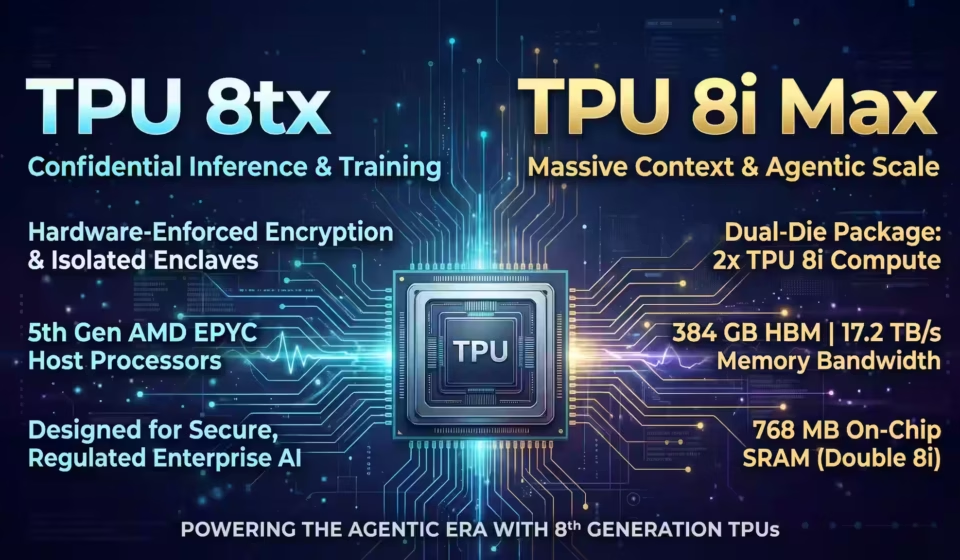
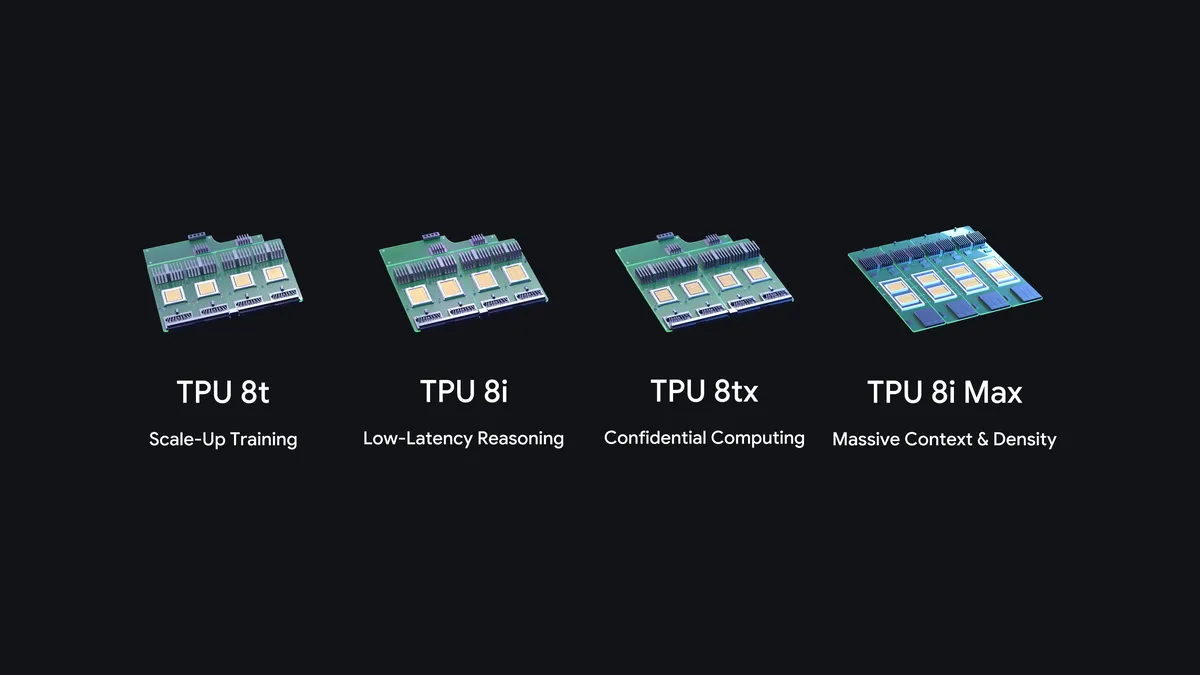
TPU 8tx (Confidential AI): Designed primarily for confidential training and inference, it features hardware-enforced encryption and isolated enclaves, operating in conjunction with 5th Gen AMD EPYC host processors. It is engineered to ensure data security for AI applications in sectors such as banking, healthcare, and highly regulated enterprises.
TPU 8i Max (Agentic Scale & Massive Context): Optimized for large context windows and agentic AI workloads, this dual-die package offers double the compute power of a standard TPU 8i. It includes 384 GB of HBM memory, a memory bandwidth of 17.2 TB/s, and 768 MB of on-chip SRAM.
The Good Side: General Advantages of TPUs
TPUs, including the 8tx and 8i Max, offer compelling advantages for any AI workload:
- Blazing Fast Performance: Dramatically accelerate model training and execution, cutting down development cycles from weeks to days or even hours.
- Energy Efficiency: Their specialized design often means lower power consumption per computation compared to general-purpose hardware for AI tasks.
- Cost-Effectiveness at Scale: For specific, heavy AI workloads, TPUs can offer a superior price/performance ratio over large clusters of GPUs or CPUs.
The Best Side: Powering the Agentic Era with 8tx and 8i Max
Where the 8tx and 8i Max truly shine is in their direct impact on the agentic era:
- Accelerating Iterative Agent Development: Agents learn through continuous cycles of trial, error, and refinement. The 8tx’s training prowess enables researchers to quickly iterate on agent policies, explore vast action spaces, and test new reasoning strategies.
- Enabling Complex Decision-Making: Real-time, sophisticated decisions made by autonomous agents require immense inference capabilities. The 8i Max provides the horsepower to run large language models (LLMs) and other complex neural networks that underpin an agent’s ‘brain’ with minimal latency.
- Scaling Autonomy: As agents become more pervasive, from personal assistants to industrial robots, the ability to deploy and manage them at scale becomes paramount. These TPUs provide the underlying infrastructure for reliable, high-performance agent operations across diverse applications.
- Pushing AI Frontiers: By removing computational barriers, these TPUs empower researchers to explore novel AI architectures and capabilities that were previously too resource-intensive, directly fueling the innovation needed for truly intelligent agents.
Key Takeaways
- TPUs are specialized hardware designed for accelerating AI workloads.
- The agentic era demands AI that can plan, reason, and act autonomously.
- Google’s 8tx (training) and 8i Max (inference) TPUs are engineered to meet these demands.
- They offer significant speed, efficiency, and scalability for developing and deploying advanced AI agents.
The rise of autonomous AI systems, known as the agentic era, requires immense computational power for continuous reasoning, planning, and decision-making. Google’s Tensor Processing Units are specialized Application-Specific Integrated Circuits designed specifically to accelerate these heavy machine learning workloads far more efficiently than general-purpose processors.
Google’s 8tx and 8i Max TPUs address these expanding computational demands by optimizing training and inference performance respectively. These specialized chips enable faster development cycles, energy efficiency, and scalable infrastructure, allowing researchers to build, deploy, and scale complex autonomous AI agents in real-world applications.
Unleashing the Next Wave of AI
The journey from basic AI programs to sophisticated, autonomous agents is one of constant innovation and increasing computational demand. Google’s 8tx and 8i Max TPUs are not just incremental upgrades; they represent a fundamental commitment to providing the specialized infrastructure necessary to unlock the full potential of the agentic era. By significantly accelerating both the training of complex models and the real-time inference required for autonomous operations, these TPUs are empowering developers and researchers to build the next generation of intelligent systems. Embrace these powerful tools to shape the future of AI.