

SEO Content Writing Guide Using AI & Free Tools – High Ranking Method

In this article, you’ll learn how to write an SEO-optimized, friendly blog using practical steps and smart AI techniques. Rank posts, increase organic traffic, and create high-quality blog content quickly. Here, I will show you step by step and also highlight how to write better AI prompts.
Below, I will explain step by step how to write an Article/Blog and make it SEO-friendly, and at the same time, how to use AI (GEMINI, ChatGPT, etc.) to get the best output. For each step, I will give small tasks, and AI prompts you can copy-paste directly and use them.
1. Plan – What to write about, for whom, and what is the goal
- Determine target keywords (Example: “How to become a young entrepreneur“, or “Cooking recipes in English“)
- Write down the main objective – information, conversion, increase subscribers, etc.
- Choose a primary keyword + (3-5 related / long-tail keywords).
Take a solution for free keyword research tools for seo & no need to pay
Quick AI prompt (research)
Write a list of 20 related long-tail keywords and search intents for the seed keyword. “best free keyword research tools” targeted at beginners. Group them by intent: informational, transactional, navigational.
2. Keyword Research – How to choose the right keywords
- Use Google Keyword Planner (GKP) or Ubersuggest/Soovle to extract long-tail keywords from seed keywords.
- Write down the intent of each keyword (who, why, how).
- Tag the competition for each keyword as easy/medium/hard. (Note: It is easier to rank if you choose low competition long-tail keywords.)
Quick AI prompt (keyword ideas)
Suggest 15 long-tail English keywords for “How to become a young entrepreneur” that have informational intent and are suitable for beginners.
3. Create an outline – Content structure
- H1 (Title) – Primary keyword should be kept.
- Intro: user intent capture + short value promise (50-80 words).
- H2-H3 should be used to write the main points (How to, steps, examples, checklist).
- Conclusion + CTA (subscribe/share/download template).
- FAQ (people also ask) 4-8 questions.
AI prompt (outline)
Create a detailed blog outline for the keyword “best free keyword research tools” for a 1200-1800 word article. Include H1, H2, H3 headings and 6 FAQ questions.
4. First draft – readable, user-friendly writing
- Write 150-500 words under each H2 (depending on topic depth).
- Keep lines short: use short paragraphs & bullet points.
- Use synonyms/LSI instead of repeating the same keyword (e.g., keyword research, keyword ideas, search terms).
- Have at least 1-2 internal links (to your site) and 1-2 external authoritative links.
AI prompt (first draft)
Write a 1200-word blog post in English using this outline: [paste outline]. Tone: friendly, actionable. Use the primary keyword “How to become a young entrepreneur” naturally in the intro, one H2 heading, and conclusion. Include 3 short bullet lists.
5. SEO-optimization (On-page SEO)
Title tag: 50-60 characters, primary keyword near start.
Meta description: 120-160 chars, include primary keyword and CTA.
URL slug: short, keyword-rich (/become-a-young-entrepreneur).
H1 Title: Should be one. H2/H3 logical.
Image: 1 image for each main section – use keywords in filename and alt text.
Add internal links with descriptive anchor text.
Ensure mobile-friendly/readable (short paragraphs, big fonts).
AI prompt (meta + title + slug)
Generate 3 SEO title variations (max 60 chars), 3 meta descriptions (120–160 chars), and an SEO-friendly slug for the article about “How to become a young entrepreneur“.
6. Content improvement – Readability & E-A-T
- Check readability – reduce sentence length, change passive > active.
- You can give short quotes to show authority (if needed).
- Add writer bio (what the writer does, why they are trustworthy).
AI prompt (improve tone & readability)
Rewrite the following paragraph to be more concise, active voice, and easier to read for beginners.
7. FAQ + Schema (structured data)
- You can write an FAQ, then add JSON-LD FAQ schema to increase the chances of getting rich results in SERPs.
- Add “How To schema” or “Article schema” if relevant.
AI prompt (FAQ + schema)
Write (3-6) user-friendly FAQ Q&A in the article on “How to become a young entrepreneur“. Then produce JSON-LD FAQ schema for them.
8. Images, visuals & diagrams
- Infographic/diagram (either manually or with an AI image tool) – will show the main points of the article.
- Image alt: short description + keyword (natural).
- Compress images (webp/jpg) and use proper srcset.
AI prompt (image alt & prompt)
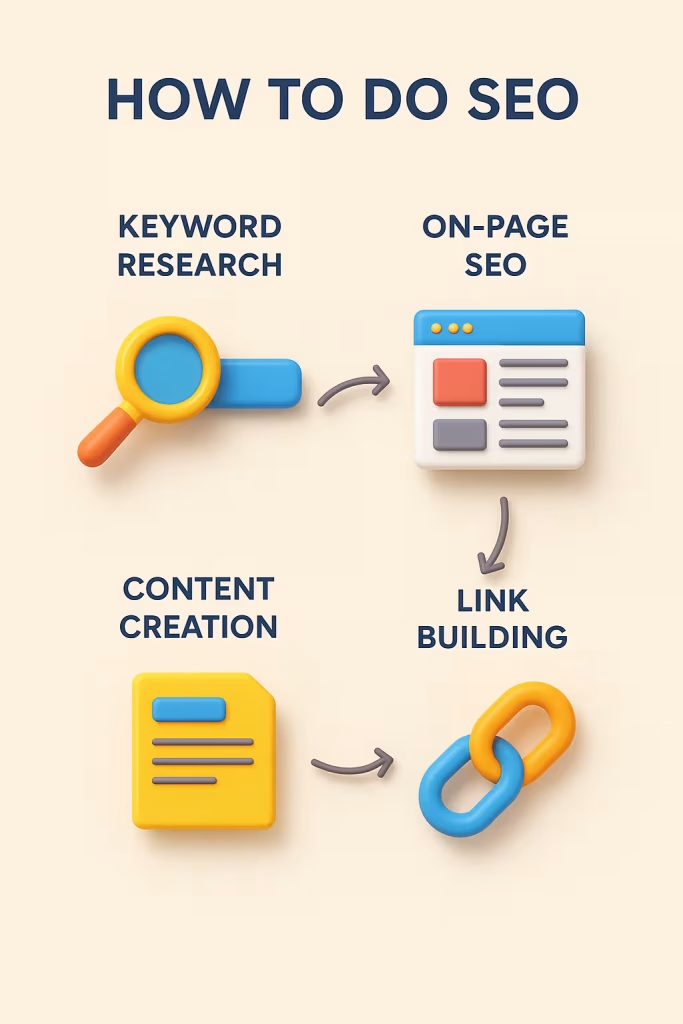
Create 3 image alt texts in English for images: 1) keyword research screenshot, 2) infographic “How to become a young entrepreneur”, 3) comparison table. Also give me a short image-generation prompt to make a colorful 3D infographic summarizing “Keyword Research > On-Page > Content > Link Building”.
9. Final SEO checklist (before publishing)
- Title tag & meta set
- URL slug short & clean
- H1 present & only once
- Primary keyword in intro, 1 H2, and conclusion naturally
- Image alt texts set
- Internal links (1-2) + External links (1-2 authoritative)
- FAQ + JSON-LD schema added
- Mobile-friendly & fast load (images compressed for the best performance)
- Check if there is a social share image (OG tags) or not
10. After publishing – Promote & monitor
- Social share: Twitter, Facebook, LinkedIn, Telegram-give custom caption + excerpt.
- Short form: Create 3-5 tweets / FB posts from the writing.
- Monitor Google Search Console (impressions, clicks) and analytics (CTR, time on page).
- Improve: If CTR/position does not increase after 4-6 weeks, then change the title/meta and A/B test.
This prompt (social posts)
5 short social posts in English for sharing the article “How to become a young entrepreneur” – including a catchy hook and seat.
Quick tips
Make more long-tail targets: rank faster when competition is low.
Patience is needed to increase rankings – publish + promote + iterate (3-6 weeks).
AI will help a lot: research, outline, draft, FAQ, meta, social copy – but fact-check yourself.
Always write humans first, search engines second – natural language and user intent need first.